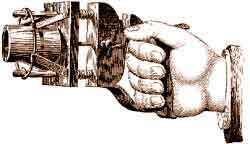
 The
Rifled Rain Repellant Apparatus
The
Rifled Rain Repellant Apparatus
(The
Bullet Brolly), circa 1873
Though not particularly known
as a force in the arms industry, MichaelFlannigan did have one
invention that was to have a major impact on the science of weaponry
- The Rifled Rain Repellant Apparatus, which was more commonly
known as the Bullet Brolly. The Bullet Brolly was based on the
design of an earlier and less successful weapon known as the Hand
Mortar. The Hand Mortar was a short barreled hand-held device
that could fire a small spherical grenade on a parabolic trajectory
to a distance of 100 meters. This early device was less than entirely
successful due to a number of reasons.
In both cases the aforementioned
"unfortunate result" was that the ammunition would explode
and blow the legs off the weapons user. Failed tests of the Hand
Mortar by the First British Engineers lead to a derisive appellation
"Flannigan's Stubby Brigade" in reference to the unfortunate
souls who tried to use this invention.
Several years later Flannigan
discovered that he could significantly shrink the size of the
device. The addition of a rifled barrel also meant that it could
be safely fired horizontally. In fact the entire apparatus could
be concealed within the apparatus of an umbrella. The Rifled Rain
Repellant Apparatus was born. The invention was an immediate hit
among the moneyed classes throughout the British Isles. It was
lightweight and provided outstanding self-defense against both
evil-doers and inclement weather.
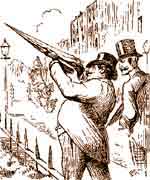 |
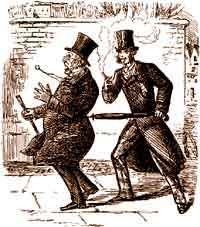
| I say old boy! Jolly good shot! |
The image at right shows an early recreational
use of the Bullet Brolly - pigeon shooting. Nothing enhanced a
gay May afternoon in London like the opportunity to head down
to Trafalgar Square to take pot shots at a few pigeons. Soon is
was more or less a fact that any gentleman carrying an umbrella
was to be treated with the utmost deference. This is a tradition
that continues in Great Britain today. In North America, however,
the Bullet Brolly had far less success as more conventional firearms
were more readily available.
It was only a matter of time
before the military took an interest in the Bullet Brolly. Colonel
William Smaggit Chesham, the Fourth Earl of Wiggit, attempted
to raise and equip an entire 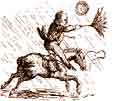 brigade
of Brolly toting light horsemen. The effort turned out to be a
failure, however, as it was found that, for a mounted, soldier
the Brolly was neither an effective weapon nor a particularly
effective umbrella. The brigade soon switch to more conventional
carbines. In the meantime the Brolly continued to enjoy brisk
sales in England, Scotland and Ireland.
brigade
of Brolly toting light horsemen. The effort turned out to be a
failure, however, as it was found that, for a mounted, soldier
the Brolly was neither an effective weapon nor a particularly
effective umbrella. The brigade soon switch to more conventional
carbines. In the meantime the Brolly continued to enjoy brisk
sales in England, Scotland and Ireland.
It was in Ireland particularly
that the Bullet Brolly gained the most fame and, perhaps, the
most infamy. The landed gentry in Ireland found that the Bullet
Brolly was particularly effective as a discreet personal defense
weapon. It gained a much more loathsome reputation, however, when
the same gentlemen began to use the Brolly as a method of fending
off "beggars, waifs, and other troublesome persons".
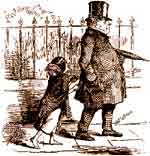 |
| A proper gentleman prepares to dispatch
a troublesome pest with the Bullet Brolly. |
"This device is a marvel," said
Lord Snivel of Branaugh. "Where before I had to expend
considerable exertions beating street urchins with my walking
stick, I need now only point this wonderful engine at them,
squeeze off a round, and be done with the sorry business. Of
course, I make it a clean and merciful shot. No use having our
street populated with beggars who are also lame."
 |
| This item in a June 1898 edition of the
Dublin Tattler carried the caption "An horrific nationalist
crime!". Note the presumption by the artist that a Bullet
Brolly was used though the weapon was never found. |
It is perhaps a particular irony
then that the Bullet Brolly also began to be carried by hard men
enlisted in the nationalist cause. Among these were such legendary
figures as Shamus "Winky" Mellon, Sean "Chuckles"
Slawene, and the most notorious of all Paddy "Long John"
O'Toole. In fact a Bullet Brolly may well have played a role in
one of the most notorious political crimes of the 19th
century, the June 6, 1898 assassination of Lord Snivel of Branaugh
by the nationalist Sean "Chuckles" Slawene.
Snivel was shot through the
back at close range with a large caliber weapon. Though never
proved, a Bullet Brolly is suspected. The local papers at the
time referred to the incident as the Brolly Murder. Though there
were no witnesses and the murder weapon was never found Slawene
was apprehended, tried, and hung for the crime on June 16, 1898.
The Rifled Rain Repellant Apparatus
largely fell out of use after the turn of the century, mainly
due to new laws in the British Isles governing the carrying and
use of concealed weaponry.
--"Scholarship" by Thuder


