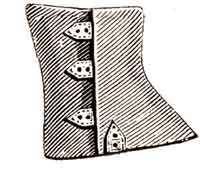
 The
Garrote-Proof Collar, circa 1862 The
Garrote-Proof Collar, circa 1862
Michael Flannigan's fertile mind gave
birth to yet another brainchild in the midst of the London Garroting
Panic of 1862. The British press had started a public panic by
providing sensationalized coverage to a crime called "garroting,"
which involved the criminal using a sleeper hold or an armbar
choke to carry out a violent robbery.(1)
Once asphyxiation had occurred, the assailant would make off with
the victim's valuables.
In response to this heinous crime,
Flannigan devised an item of personal security clothing, the "Garrote-Proof
Collar." The Collar was a high-necked garment enhancement fortified
with oakum and tin that clipped on to any man's shirt or woman's
blouse. With this innovative yet low-technology invention, Flannigan
showed -- not for the first time -- his considerable grasp of
both function and fashion; the Collar was stiff enough to rebuff
unwanted strangular advances, yet sufficiently comfortable and
stylish to wear in almost any circumstance.(2)
In these dangerous times where citizens literally "risked their
necks," (3) sales
of the Garrote-Proof Collar were brisk.
The Personal
Digital Assistant, circa 1897
Flannigan's deepest expertise lay
in the physical sciences and engineering disciplines. However,
he was a widely-read observer of the human condition, and a social
scientist by predisposition, if not by profession. He also had
a prodigiously productive set of nasal membranes. As a result,
Flannigan was intimately familiar with the field of rhinotillexomania.
(4)

"The Personal Digital Assistant" -
also known as the "Nugget Extraction Contraption" - represents
Flannigan at his best: delving deeply into the problems of mankind,
and proposing simple, effective, multi-purpose solutions. This
hand-operated mining machine enabled faster and more sanitary
removal of nostril obstacles, reduced nasopharyngeal hemorraghing,(5)
and proved equally useful for removing pickled onions from jars.
Tragically, the enormous success of
the Personal Digital Assistant would soon be followed by Flannigan's
ill-starred experiments with the Nostril-Stretching-and-Hair-Clipping
Apparatus.
 Flannigan's
Drawing Board Flannigan's
Drawing Board
Shortly after Michael Flannigan's
untimely death in 1901, all of his sketches but one were burned
by an over-cautious insurance adjuster concerned about future
liabilities arising from cranial injuries. Fortunately for the
advancement of Flanniganalian scholarship, his executors (the
esteemed law firm of Thwhack, Bludgeon and Blowe) found a number
of the visionary inventor's unfinished creations - partially assembled
or incompletely blueprinted - while rooting about in an old garden
shed looking for Flannigan's pruning shears. An incomplete list
of these less-than-finalized contrivances is provided here for
the reader's elucidation, with explanatory notes to the extent
that they exist.
'Stache Stencil
and Trimming Tackle
Flannigan's Last Will and Testament
clearly indicated his remorse about, and intention to improve
upon, the shortcomings of "The Single Action Facial Hair Removal
Device." Blueprints show a selection of stencils in the shape
of common facial hair configurations, and a series of tiny safety-scissors
suspended from forehead scaffolding. Future users of Flannigan's
"Snipping Suite" would have had nothing to fear from their shaving
tackle.
The Faux-Nez
This device seems to have been intended
to improve the quality of life for those who had "lost a loved
one" - if, in fact, such an intimate relationship can exist between
a man and his facial features - to Flannigan's "Single Action
Facial Hair Removal Device." Pencil sketches for this presumably
prosthetic device show a pair of horn-rimmed glasses and a thick
black moustache, separated by what appears to be a large Irish
potato.
The Domestic
Drawbridge and Portcullis Commercial Traveler Discouragement Device
Possibly meant as a literal fulfillment
of Sir Edward Coke's belief that "a man's house is his castle,"
this contraption is the only completed element of Flannigan's
long-anticipated, but unfinished Englishman's Home Castle Kit.
The plans for the redoubtable Commercial Traveler Discouragement
Device show clearly how to retrofit the front door of a standard
residence in order to repel advancing commercial travelers, door-to-door
religious zealots and politicians. Interestingly, this may be
Flannigan's only invention actually intended to cause blunt and
severe trauma to the head. Margin notes refer to a planned Battlement
and Boiling Oil component, but no further detail is provided.
Kung Fu Grippe
This topic has caused significant
academic schism. In his last conscious moments, Michael Flannigan
grabbed the wrist of a rather scrumptious nurse and pulled her
toward him, thrusting an ink-stained bar napkin at her. Holding
her arm in what can only be described as the fierce and desperate
grasp of a dying man, Flannigan is reported to have whispered
"The Grippe, the Grippe!" before slumping into a coma. These words,
uttered so desperately, seem oddly misplaced in that Flannigan
was dying not from influenza, but as the result of a "catastrophic
nasal hair loss" suffered in a tragic laboratory mishap.
Nurse Dahlia Dose, a noted scholar
of Oriental languages as well as a dedicated health professional,
reported that the napkin contained two Mandarin characters: "Kung"
-- meaning energy -- and "Fu" -- representing time. Did these
last words refer to Flannigan's foresights into cold fusion? Time
travel? Rechargeable batteries?
Sadly, Michael Flannigan's final moments
of near lucidity have revealed no further indication of precisely
what great advance the great inventor meant to leave as his final
gift to humanity.
--"Scholarship" by the
Flyboy
Notes:
1) Despite the media
attention, such strangulation was a fairly uncommon crime, but it
did lead to the enactment of new laws aimed at controlling working-class
violence and non-white protest. In other words, while aristocratic
English rowdies were simply boisterous young gentlemen at play,
working-class Jamaican women protesting government repression were
ungrateful wretches who deserved whippings on bare buttocks with
piano wire. [Back]
2) It was also useful
in the medical treatment of any patient who had suffered whiplash
from the overly rapid halt of a hansom cab. [Back]
3) Interestingly, the
Garroting Panic had caused Londoners to go about their business
with downcast eyes and tucked-in chins. It is unclear whether the
common phrase "Chin Up!" developed before the invention of the Garrote-Proof
Collar as an exhortation of societal encouragement or, after the
fact, as an exclamatory description of the wearer's personal posture.
[Back]
4) Compulsive nose
picking. [Back]
5) Epistaxis digitorum
[Back]
|


