The Comet
Suit, circa 1898
Like all good men of science
and discovery, Michael Flannigan kept up with the latest scientific
journals and publications. In the late 1890s he become very concern
with reports about the imminent 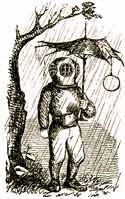 return
of Halley's Comet. Crude astronomical calculations of the day
showed that the comet was going to come very close to the Earth
upon its return in 1910. Though only the most apocalyptic commentators
believed that the comet would strike the Earth, most agreed that
the Earth would pass through the comet's tail (as indeed it did).
Nobody knew for sure what effect comet tail gasses would have
on the Earth.
return
of Halley's Comet. Crude astronomical calculations of the day
showed that the comet was going to come very close to the Earth
upon its return in 1910. Though only the most apocalyptic commentators
believed that the comet would strike the Earth, most agreed that
the Earth would pass through the comet's tail (as indeed it did).
Nobody knew for sure what effect comet tail gasses would have
on the Earth.
Flannigan was particularly concerned
about the implications of this event and designed an outfit to
protect the wearer from the corrosive gasses from outer space.
Flannigan died before the suit could be produced. Fortunately,
when comet Halley did return, its gaseous tail did no more than
produce a spectacular light show for the inhabitants of the Earth.
The
Single Action Facial Hair Removal Device,
circa
1899
In an age when the programmability was
limited to player pianos, this ultimately flawed creation stands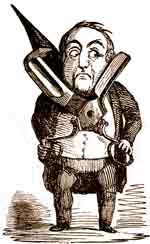 out as a splendid example of programmable technology. The single
action facial hair removal device could remove all facial hair
in a matter of seconds. In the first use a roller was used. When
the roller moved across the facial features contour information
was stored on a player-piano-like scroll. The roller was then
replaced with a blade (as seen at left). When the scissor-like
apparatus was closed the blade would cross the face in "exact
remembrance of the gentleman's visage".
out as a splendid example of programmable technology. The single
action facial hair removal device could remove all facial hair
in a matter of seconds. In the first use a roller was used. When
the roller moved across the facial features contour information
was stored on a player-piano-like scroll. The roller was then
replaced with a blade (as seen at left). When the scissor-like
apparatus was closed the blade would cross the face in "exact
remembrance of the gentleman's visage".
If built with today's precision technology,
this device might actually work. Unfortunately, construction in
Flannigan's day was not up to the task. The accidental severing
of noses, lips and chins among early adopters of the device lead
to its quiet abandonment.
(Additional Note: One of the unfortunate victims of this
failed device went on to some success years later as a professional
hockey player. "Face-Off" Norton also gave the game
one of its pre-eminent terms.)
 The
Companion Carrier,
circa 1900
The
Companion Carrier,
circa 1900
Designed for the "man who would be with his mate while she
is about her work", the companion carrierhas the dubious
distinction of being the least favorite invention of Flannigan's
normally adoring niece Emily Chesley. When the London speculative
fiction writer saw sketches of the Companion Carrier she flew
into a rare rage against her uncle. Accusing Flannigan of treating
the woman as a pack animal she also noted the device represented
the "most uncomfortable, unnecessary, and unpleasant form
of mounting ever devised." All of Flannigan's sketches were
burned except for the one at left which was found after the inventor's
death in a folio labeled "Meaningless Drivel".
--"Scholarship" by Thuder


