The Dancing Music Box,
circa. 1882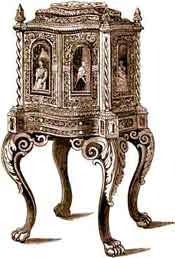
The dancing music box was an incredible early
application of robotics. In Flannigan's day, the parlor was the
center of family entertainment. This device was meant to be a
parlor diversion, something to entertain the family after the
singing and reading was done. A small removable crank was used
to wind up the device. When a release switch was opened a pleasant
tune would issue from the contraption and the figurines would
dance about.
But that is not all! The oddly shaped
tiger paw legs of the dancing music box where also movable. Spring
powered servos in the "hips" of the device would move
the legs in time with the music. Soon the box itself would be
in full jig across the parlor. Though expensive, this item did
reach production and several copies were bought including one
by the Tsarina Alexandra of Russia. Unfortunately the prohibitive
cost of the devices kept them out of the middle class parlors
for which it was designed.
--"Scholarship" by Thuder
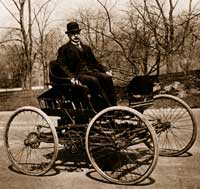 The
Flannigan Flyer, circa
1884
The
Flannigan Flyer, circa
1884
Powered by a noxious combination of
uric acid and bat guano, the world's first motorcar never gained
the acclaim that some of Michael's other inventions did, though
it certainly was noticed by passers by and the other good folk
who lived on Maitland Street. Local residents could often be seen
holding their noses, and exclaiming in a nasal-pitched tone: "Good
Lord, here comes that farty Bog-trotter with his pestilent contraption!"
--"Scholarship" by The
Squire
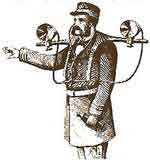
Emily Chesley's uncle Michael Flannigan
demostrates his auditory
directional apparatus, circa
1849. The invention was intended to provide the military
with a way of judging the direction and distance of enemy artillery.
The Royal Artillery dismissed the invention choosing instead to
rely on mathematics as well as the visual observation of muzzle
flashes and smoke.
--"Scholarship" by Thuder
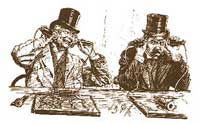 Two gentlemen try out Michael Flannigan's sympathetic
vibratory earwax remover, circa
1861. (The man on the left appears to be particularly enjoying
the experience). The device, which produced a high pitched whine
that was said to break up wax in the ear canal, was popular with
the moneyed classes despite its capacity to rupture eardrums and
produce hemorrhaging. The device was considered far more modern
and civilized that the tool employed by common rabble: cotton
swathed around the end of a little stick.
Two gentlemen try out Michael Flannigan's sympathetic
vibratory earwax remover, circa
1861. (The man on the left appears to be particularly enjoying
the experience). The device, which produced a high pitched whine
that was said to break up wax in the ear canal, was popular with
the moneyed classes despite its capacity to rupture eardrums and
produce hemorrhaging. The device was considered far more modern
and civilized that the tool employed by common rabble: cotton
swathed around the end of a little stick.
--"Scholarship" by Thuder


