 |
Emily's Biography | The Oeuvre | Flannigan Bio | The Inventions |  |
| Associated Figures | Literary Contest | The Frolics Store | About the Circle |
|
|||||||||||
| Emily Chesley - a biography | |||||||||||
|
|
|||||||||||
|
Peruse her biography:Formation (1856-1880)London, Ontario (1880-1904) Travels (1904-1919) A Long Twilight (1919-1948) ...Chesleyan Timeline ...The Oeuvre
|
The Not-So-Bleak
|
||||||||||
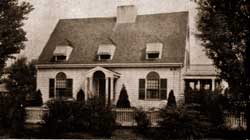 |
| Archival photo that researchers have identified as the house on Princess Ave. (Photo courtesy: Peabody-Snodgrass Archives.) |
The home is most often referred to in Chesleyan scholarship as being the "house on Princess Ave". It is also referred to as a large and rambling Victorian mansion. However there are a number of references - particularly in relation to Emily's Uncle, the inventor and locationist Michael Flannigan - to the residence being located on Maitland Avenue. An 1893 London Free Press article names 45 Maitland as Flannigan's residence (See the Mammary Sympathizer). The speculation that the house was on the corner of Princess and Maitland, with frontage on both streets, has itself fed the notion that Emily's residence was none other than Bleak House, a site of considerable historical importance to the city. It was at Bleak House that a founder and key figure in London's history, Colonel Thomas Talbot (1771-1853) spent the last days of his long life (See the self-published pamphlet Talbot: The Drooling Years, by London historian Fergus "Fergie" Ferguson). George MacBeth, a longtime servant and business manager for Talbot, built the house at Princess and Maitland. Known as "the Koot's Keeper" by disgruntled Talbot relatives, MacBeth was blessed with quite a large portion of the Colonel's estate and became an instant prominent citizen in 1854.
The property purchased by Michael Flannigan in the spring of 1880 was not Bleak House but Snodgrass Place, another property near the intersection of Princess and Maitland. The house was built in 1860 by Colonel Norbert Peabody Snodgrass (Retired), a veteran of the War of 1812, who had made a small fortune when oil was discovered on his Lambton County property in the late 1850s. The fortune was quite small and most of it was spent on the construction of the rambling Victorian house. "Colonel" was also an honorary title for Snodgrass. During the war he had never risen above the rank of regimental drummer's assistant. This, however, did not stop the old man from staging colorful marches on his front lawn, in full dress uniform, providing his own accompaniment on a little toy drum. In short, Snodgrass was quite mad.
 |
| Snodgrass began his military career early in life. |
In December 1865 the British North American territories were swept with fear of an imminent invasion by the Fenians, an American society of Irish Nationalists, many who were veterans of the recent War Between the States. Snodgrass leapt to the defense of his countrymen, pledging to raise and equip a regiment of militia. Unfortunately, Snodgrass could only afford a few hundred red blankets and some broomsticks. With nobody flocking to his colors the unfortunate Colonel had to resort to snow men. In one of those serendipitous moments that occur during warfare, an actual Fenian raiding party of about fifty men came across Snodgrass's "regiment" near Niagara on the Lake in February 1866. The raiders formed a line and, with one volley, dispatched most of the regiment as well as Snodgrass who was affixing a carrot to the face of his second lieutenant third platoon. The body was not found until the spring, still clutching a desiccated carrot. The cause of death would remain a mystery for many years, until an account of the skirmish was found in the journal of one of the Fenians, Seamus "Shorty" Dicke.
"We'd been fooled by McGruder's theatrics on the Peninsula in '62 and again by those log cannons at Fredricksburg," wrote Dicke. "We weren't about to be fooled again."
The Fenians returned to the United States to report that a stronger invasion would not be opposed. They were proved wrong the following spring at the Battle of Ridgeway.
Snodgrass Place stood empty for a couple of years and was eventually purchased by another eccentric Victorian by the name of "Belfry" Bob Teesdale. While not as insane as Snodgrass, Teesdale did have an odd obsession. He believed that bats could be domesticated to serve the army as nighttime carrier pigeons. An apothecary by day, Teesdale tended to his strange hobby on summer nights. This went on for many years but came to a tragic end in the summer of 1877. Alice Dear, a child of 9 at the time, recounted the event years later.
"There was an awful scream from across the street that went on and on. Suddenly, Belfry Bob came tumbling out his front door wearing what looked like a big furry coat and hat with flappy leather bits all over it. 'For God's sake get them off. Get them off!' he cried as he staggered to the middle of the street and collapsed. 'Don't look, Alice' said Mommy as she covered my eyes. Then she cursed Mr. Teesdale for a damn fool and called to my brother Toby to fetch her broom."
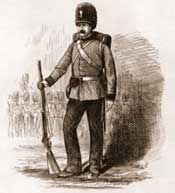 |
| Soldiers line up on "The Artery" as the cobbled walk leading to the house on Princess Ave. was known by neighbours. (Illustration reproduced from the National Library of Canada's website (www.nlc-bnc.ca).) |
The house again stood empty until its purchase by Flannigan in 1880. By then the house had quite the unfortunate reputation, a reputation that was not helped when the locals found that Irish were moving there. Michael's brogue in particular was a cause for local suspicion, especially a mere few months after the troubles up in Bidulph Township (See Die Donellys! Die! Die! Die Y' Bastards! by Lou Canboye as well as Donellys: A Swell Though Misunderstood Bunch by Prof. A Ravejh Nist.). The new occupants also seemed to be immune to the lingering odor of guano emanating from the house. The young Emily, however, found some acceptance particularly among the members of the 7th Regiment. So much so that neighbors nicknamed the cobbled walk leading to the front door of Snodgrass Place "The Artery" because of the constant flow of corpuscle-like red bodies up and down the walk.
Emily's fondness for the red-tuniced men of the 7th Regiment has lead to speculation that that her home was further west on Princess Ave closer to Victoria Park. London was historically a garrison town and Victoria Park is the location of the city's first large-scale barracks. However, while it is true that the 7th Regiment (or more properly the 7th Battalion Fusiliers) may have used Victoria Park as a parade ground, the park had not been used for a barracks since 1869. There are also the persistent references to Flannigan's workshop being located on Maitland, with concurrent references to Emily and Michael continuing to reside on Princess Avenue. A figure no less prominent than Charles Dodgson (a.k.a. Lewis Carol) is said to have helped pay for the Maitland property (See Associated Figures: Lewis Carol).
 |
| Flannigan later admitted that he might have overdone the size a bit on his prototype Subterranean Tubular Passageway Digging Device. |
In part to provide more space for his experiments, and in part to provide some distance between his reputation and that of his lovely niece, Flannigan purchased a small cottage on an adjoining lot around the corner from Snodgrass Place in 1890. To connect the two buildings, Flannigan used a new invention called his Subterranean Tubular Passageway Digging Device. The large drill-like device worked like a charm and lead Flannigan to speculate that he could one day create a complete network of subterranean tubular passages for the entire city. This dream was dashed, however, when the digging device was accidentally left on automatic while it was on a steep grade. Digging straight down it was soon lost from sight and never recovered. Rumors that the device re-surfaced some 12 years later near Chu Maidong China have never been verified.
Much of what occurred over the years at Snodgrass Place has been documented elsewhere. The house fell into serious disrepair in the new century after the death of Flannigan and during Emily's prolonged globetrotting absences. It became even more an eyesore when the state-of-the-art Lord Roberts School sprung into being across the street in 1915. During Emily's final prolonged absence between 1919 and 1924 her long-time housekeeper, Mrs. Beasley, died. The body, still clutching a feather duster, was not discovered until Emily's return. The property was sold soon after that.
By the end of the 1920s all the structures that had been part of the Chesley/Flannigan property had been demolished. Some of the subterranean tubular passageways, including the "deep hole" where the digger was lost, were never found and became the stuff of legend. To this day, residents of the area still occasionally complain of the smell so Szechwan Beef emanating from their basements.
Emily's Bio | The
Oeuvre | Flannigan
Bio | Inventions
Associated Figures
| Literary Contest
| The
Frolics Store
About the Circle | Search
this Site | Home
Join our mailing list or send us email.
All written material, graphics, logo, and html coding
© copyright 2003-2005 The Emily Chesley Reading Circle
Web Monkey: Mark A. Rayner

