|
Emily's Biography | The Oeuvre | Flannigan Bio | The Inventions |  |
| Associated Figures | Literary Contest | The Frolics Store | About the Circle |
|
|||||||||||
| Emily Chesley - a biography | |||||||
|
|
|||||||
|
Peruse her biography:Formation (1856-1880)London, Ontario (1880-1904) Travels (1904-1919) A Long Twilight (1919-1948) ...Chesleyan Timeline ...The Oeuvre
|
Roll Out The Barrel: The Aborted Niagara ChallengeThroughout the 19 th century, Niagara Falls was a Mecca for daredevils, adventurers, inventors and other assorted loonies from around the world. Given the relatively close proximity of London Ontario to the Falls, one has to wonder why neither the adventurous Emily Chesley or her inventive Uncle Michael Flannigan ever attempted to conquer the falls. One need not wonder further. In 1900 Michael Flannigan did set his sights on Niagara Falls. The result was one of the few heated arguments ever between Emily and her uncle.
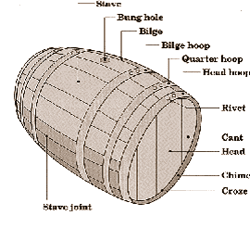
Throughout the 1800s, most of the Niagara daredevil feats had been confined to tightrope walking across the Niagara gorge, as well as riding or swimming the whirlpool rapids below. By the end of the century nobody had yet attempted to survive a plunge over the falls. This is the challenge which the increasingly dotty Michael Flannigan chose to conquer. Working in his Maitland Ave workshop, Flannigan constructed his Vehicle for Dropping From a Great Height and Splashing About in Rapids. It was also known more simply as the Flannigan Bobber. The invention consisted of a barrel-like structure. Inside there was silk pillows for padding and a large anvil for ballast. There only remained one question: who would pilot the vehicle over the brink and into the watery hell below? The answer was the source of friction between Flannigan and Emily Chesley. Upon hearing of her uncle’s plan, Emily believed that she was the logical choice for the task. For the first person over the falls to be a woman would be a coup for women everywhere. There was also a long and illustrious history of women daredevils who had challenged the falls. Some were successful. Others, sadly, were not. There was, for example, the lovely and buxom Maria Spelterini who walked tightrope across the gorge a number of times in the 1870s. On one occasion she walked the wire with manacled legs. On another occasion she wore buckets on her feet. Less successful was the unfortunate Maude Willard. Her barrel became trapped in whirlpool for several ours. She succumbed to asphyxia while her pet dog survived by sticking his snout through the craft’s only air hole.
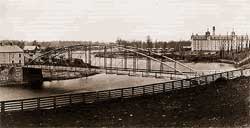
Michael Flannigan appreciated the enthusiasm of his darlin’ niece, but was dead set against her going over the falls. Though eternally an optimist, Flannigan was more than aware that a number of his past inventions had ended badly – often involving dismemberment and/or massive cranial bleeding. For the Niagara adventure he selected a local gymnast and trapeze artist Ryder “Doggie” Stiles. Stiles had gotten his nickname for his compact build, energy, and alert demeanour – which was not unlike a frisky Jack Russel Terrier or an enthusiastic Beagle pup. While Emily was impressed by the young Stiles’ physicality – and particularly his flexibility – she was nonetheless unimpressed by her uncle’s decision. “I admit he is wiry and flexible,” Emily said, at a meeting of the Celtic Union of Non-Testosterone Sybarites. “But he’s so small that the two of us could fit in Uncle’s contraption. Hmmm.” Meanwhile, Flannigan pushed ahead with his plans. He decided that, before the assault on Niagara, there would be a public test of the device. This would have the bonus of drumming up some publicity for the main event. So it was that on April 14, 1900, the Flannigan Bobber was dropped into the rushing Thames River from high atop the wrought iron girder work of the Blackfriars Bridge. The bridge, which spanned the river between London and the hamlet of “Petersville” on the west bank, still exists today. A platform was built atop the apex of the bridge’s girders. From there the Bobber was to be dropped into the river. From their it would float down river to the Dundas St. Landing. The day of the great test a large crowd of spectators, many looking to watch “Old Flannigan’s latest disaster” lined the river banks. Flannigan and Stiles waved from the top of the bridge. Emily was nowhere to be found. It was assumed that she was still sulking over her uncle’s rejection. Picking up the story is the only surviving eyewitness account by one Phineas Hornblatt. Ironically, Hornblatt was present 20 years earlier to recount the Victoria disaster and the infamous Thong Bank incident. He writes:
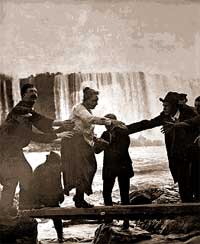
Sadly, the Flannigan Bobber was never to see Niagara Falls and “Doggie” Stiles would not be a hero. Within a year, the redoubtable Flannigan was dead, the victim of a freak nasal hair removal accident. The flexible Stiles also soon met his own end. While doing back flips to impress a crowd on Dundas Street he was crushed between two cable cars. On October 21, 1901, Mrs. Annie Edson Taylor, became the first person to survive going over Niagara Falls in a barrel. The 46 year old widow and school teacher from Bay City, Michigan, accomplished the feat in a large wooden barrel which was padded with silk pillows and used an anvil for ballast. Seeing that Niagara Falls had been conquered, by a woman, in much the same fashion as she had planned, Emily lost interest in the project. |
||||||
|
Join our mailing list or send us email. All written material, graphics, logo, and html coding Web Monkey: Mark A. Rayner
|
 |
||||||