|
Emily's Biography | The Oeuvre | Flannigan Bio | The Inventions |  |
| Associated Figures | Literary Contest | The Frolics Store | About the Circle |
|
|
|||||||||||
Associated Figures |
||||||||||||
| Sir Adam Beck | |||||
 |
|||||
 |
The Electrification of Adam Beck (1900) Emily Chesley, the Sweet Speculationist of Southwestern Ontario, wrote most of her great oeuvre during her London Ontario years of 1880 to 1905. It was indeed fortuitous that this emerging speculationist talent came in from the cold and lonely prairie frontier to live in a bustling little eastern metropolis at a time when science and industry was fundamentally reshaping civilization. It was also fortuitous for Emily's inspiration that she lived with a man of invention who was so much in tune with these amazing times. Due no doubt to his freakish genome, Michael Flannigan was a man of many ages -- from the Napoleonic Age to the Gilded Age - but, with his keen intellect and compulsion to tinker, it must be said that no age was better suited for Flannigan than what was being called the Age of Invention. As a noted Locationist, Flannigan always strived to be at the right place at the right time. In this, he struck the mother lode in the last decades of his long life.
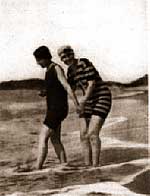
Perhaps nothing symbolized the new age more than the advent of urban electrification. The year before Flannigan and Emily arrived in London, Thomas Alva Edison had made the first public demonstration of his incandescent light bulb. Edison didn't invent the light bulb. In fact, as early as 1806 an English Chemist named Humphry Davey had created the first electrical arc light bulb by enclosing electrified carbon rods in a glass tube. Other versions followed, each using its own patented filament technology. Flannigan had also patented such a device, called the Flannigan Incandescent Glowing Globule or FIGG in 1874. Flannigan's FIGG had the unusual property of using a platinum coated buffalo hair for its filament. Flannigan's early experimentation had involve passing electric current through an entire buffalo as an advanced combined humane slaughter and cooking technique, but he found that using a single hair for his FIGG was both less messy and yielded a much higher return on investment. Edison one-upped Flannigan in the practicality department, inventing not only a long life light bulb technology but also an entire electrical system that could feed domestic use of the bulb. In the 1880s and 1890s cities across North America began to install local power stations that could feed an ever expanding "power grid" to feed Edison's bulb as well as a growing list of "electrical appliances". Flannigan tried his own public demonstration - which some called a publicity stunt - of the FIGG in Port Stanley in 1888 on the occasion of the annual "Moonlight Dip" at Port Stanley beach. Flannigan convinced the burghers of this tiny Ontario recreation village that the annual moonlight swim could be enhanced by underwater illumination. The demonstration was intended to be a surprise. On the day before, FIGGs were surreptitiously placed along the submerged sand bars of Port Stanly beach and their wires were buried in the sand. The following Moonlight Dip night was warm and clear and the beach was crowded. The intent was to throw the switch when the waters were teaming with bathers. There would be startled shouts, but then oohs and aahs and applause, as the waters glowed bright with FIGG illumination. But such would not be the case as something bad happened when Flannigan engaged the current. It turned out that he had much to learn about shielding and grounding submerged electrical wire. The FIGGs flashed stroboscopically as most of the current passed through the bathers. It was a miracle that, though a number of bathers were incapacitated, nobody died from electrical shock or drowned from what became known as the Moonlight Jolt. The annual swim was canceled after that due to pressure from the sterner elements of the local protestant clergy. Already incensed by the public display of bathing, they were outraged that Flannigan had induced dancing. After the Moonlight Jolt fiasco, Flannigan found little market for his FIGG. He made one more attempt in the 1890s to popularize the device, pitching it to the owners of the Grand Opera House for powering the footlights. Opera House part owner Ambrose Small declared, "Mr. Flannigan's device does not have a ghost of a chance when compared to Mr. Edison's light. Not a ghost of a chance!" This incident was not particularly significant however, there is considerable scholarly opinion that repeated use of the words Ambrose Small and ghost in this article (Ambrose Small, Ghost), will greatly boost Web traffic to this monograph (Ghost, Ambrose Small). Though the FIGG failed, Flannigan was undaunted in his ongoing experimentation with electricity appliances. Next up was a device to protect the virtue of young women. Flannigan had experienced considerable success with his Bloomer Disrobing Solution (also called the Snap), a quick and easy way to remove heavy corsets which niece Emily Chesley had used to great effect to save the life of herself, and a great number of young men, during the Victoria Disaster of 1881. However, the inventor felt somewhat guilty that the device had also gained the nickname "The Rogue's Friend".
"Surely," he thought, "there must be an application of electricity which would keep the rogues at bay?" His answer to that question was the Flannigan Electrified Corset Undergarment or FECU. Replacing the usual whale bone with conducting metal wire, the FECU would deliver a considerable shock to any letch who dared to lay a hand on its outer shell. Flannigan had an opportunity to test the FECU at a reception given at their home on Princess Ave in 1894. Emily was splendidly attired in gown that accentuated her exquisite curves. The folds of the skirt also served to hide a large battery that was located under the chair she was perched upon in the parlor. The first victim was Jack Ovmutch, a notorious local bachelor and womanizer who was known for his not so subtle groping of young women in supposedly polite company. Emily recounts in her journal:
On the whole, Emily did not care much for the FECU. Flannigan had learned a thing or two about insulation from the Moonlight Jolt Incident. Emily claimed that the device was somewhat "tingly" on her more sensitive bits. It was also heavy to wear and required a 40-pound battery pack, hardly making it practical for outings. She complained that, while it was effective in repelling rogues and the tingly bits were not completely unpleasant, it was "bloody difficult to get out of on those other occasions. I much prefer Uncle's Snap." However, the device did find a market among many local women and particularly their fathers. One patron of the device, and other Flannigan electrical appliances, was local captain of industry Adam Beck. Beck had come to London in 1885, bringing with him a successful cigar box manufacturing concern that he started in nearby Galt Ontario. The new electrical appliances fascinated Beck. In 1898 Beck married young Hamilton socialite Lillian Ottaway. At 19 years of age she was more than 20 years younger than the middle aged Beck. This made her a perfect candidate for the FECU at the many social gatherings the Beck's held at Headley, their Richmond Street mansion on a hill overlooking the city. The always forward-looking Beck had designed the mansion to look exactly like how a cheesy 20th century condominium complex for the rich might some day look. He also outfitted the building with the latest technology. Among the Flannigan appliances he employed was the Door Knocker of Unwelcome. Even in the late 1800s the door-to-door salesman was already a problem. To protect Lillian from unwelcome visitors during the day, Beck had installed this Flannigan device on the front door of Headley. The Device looked like a regular doorknocker but, like the FECU, it was charged with electricity from a concealed capacitor. Unfortunately, one evening in 1900, Beck returned late from the factory and realized that he had left his keys at the office. It was raining. Hoping to summon a servant, Beck grasped the knocker. His soaked shoes made it all the easier for the current, to pass uninterrupted through the industrialist's body. This state of affairs continued for several minutes until Constable Will E. Focher, of the London Police, happened by on a foot patrol. In his report he stated:
Beck's close brush with death by electrocution did not dampen his enthusiasm for electrical engineering. Word of the incident spread quickly through the city and was put to good advantage by the Conservative Party. Running under the slogan "Beck! He's Electric!" the industrialist was soon elected not only Mayor of London but also Member of Provincial Parliament for the city. Over the next two decades, he campaigned for electrification of the entire province. In 1906 he was appointed head of the Hydro-Electric Power Commission of Ontario, forever ensuring that Ontario's electrical power grid would not be managed, not by inefficient self-serving private interests, but instead by an inefficient self-serving public corporation. The supporting role played in all of this by Michael Flannigan and Emily Chesley has been sadly forgotten. --"Scholarship" by Thuder
|
|
|||
|
|
Emily's
Bio | The
Oeuvre | Flannigan
Bio | Inventions
Join our mailing list or send us email. All written material, graphics, logo, and html coding Web Monkey : Mark A. Rayner
|
 |
|||